In Atlantis, Your Address Decides What You Owe at Closing
August 13, 2026
August 13, 2026
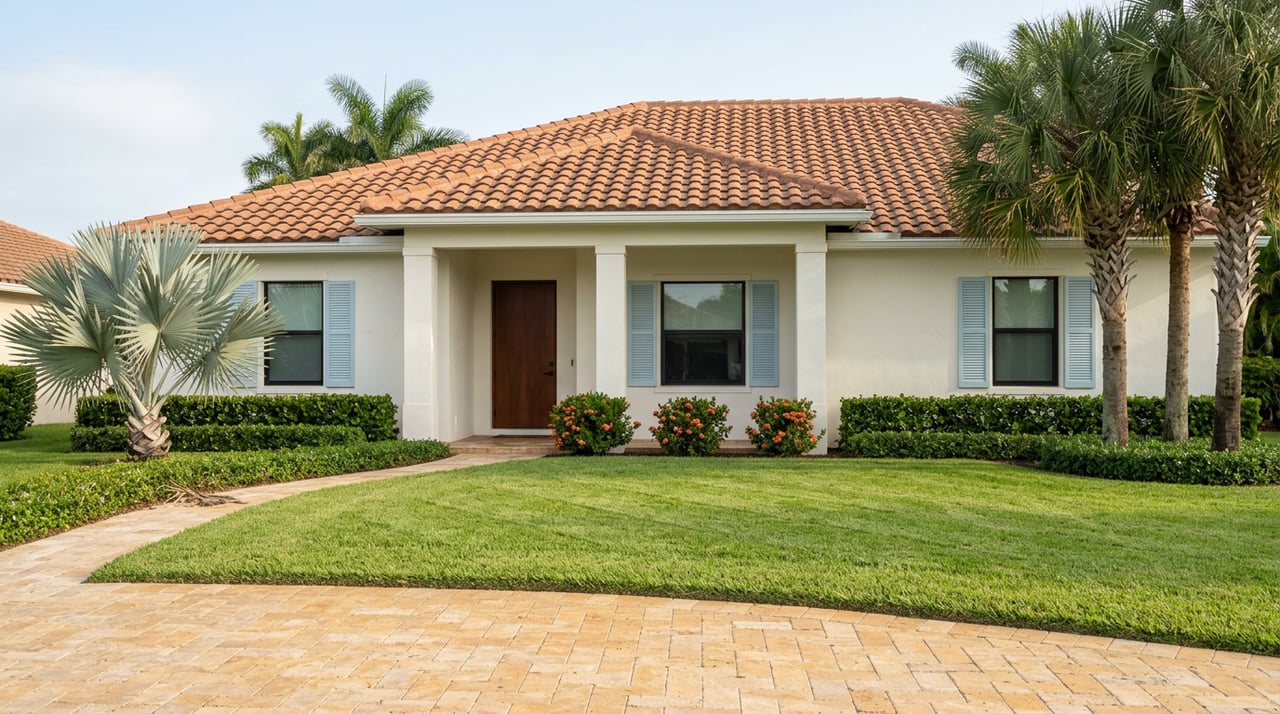
Drive down South Country Club Drive in Atlantis and you'll pass a home marketed plainly as sitting inside a "non-HOA golf community." Turn two streets over into The Palms at Atlantis and you'll find houses where golf club dues are written into the title itself, a condition of ownership that has nothing to do with whether anyone in the house plays golf. Same city. Same zip code. Two completely different sets of obligations attached to the deed.
That gap is the thing sellers in Atlantis tend to discover too late. The city gets talked about as one golf community, but it was built as roughly a dozen separate subdivisions wrapped around two courses that operate on opposite models. What you owe, what you disclose, and how fast your closing moves depends on which of those subdivisions your specific address sits in, not on the reputation of Atlantis as a whole.
Atlantis has two courses, and they don't work the same way.
Atlantis Country Club is semi-private. It's an 18-hole championship course open to the public year-round, with several tiers of membership available and both casual and formal dining on site. You don't have to live in a particular subdivision or join anything to play a round there, and homes near it don't automatically carry club obligations.
Lost City Golf Club is private. It offers 27 holes across three nine-hole layouts, and both the course and its restaurant are accessible by membership only. Homes in communities built around Lost City, including The Palms at Atlantis, can carry membership as a condition tied to the property itself rather than a lifestyle choice made by whoever happens to own it.
| Atlantis Country Club | Lost City Golf Club | |
|---|---|---|
| Access | Semi-private, open to the public | Private, members only |
| Layout | 18-hole championship course | 27 holes across three nine-hole layouts |
| Dining | Casual and formal, open to non-members | Restaurant limited to club members |
| Typical home relationship | No automatic club tie for nearby homes | Membership can be a condition of title in specific subdivisions |
If your home sits near one course, the assumptions a buyer makes about the other course simply don't apply to you. That's worth spelling out early, not discovering during the buyer's due diligence period.
The listing on South Country Club Drive isn't an anomaly. It's an example of how sellers in certain Atlantis subdivisions actively market the absence of mandatory dues as a selling point, because in a city known for club-tied living, "no HOA, no mandatory membership" is genuinely differentiating information for a buyer comparing options.
In communities where membership is mandatory, that requirement usually isn't a preference the homeowners association enforces socially. It's written into the declaration recorded against the property, and it runs with the title regardless of who owns the home or whether they ever set foot on the course. That's a different animal than an optional social membership you can decline. Before you price your home or write your listing description, you need to know which category your specific parcel falls into, and that answer comes from the declaration on file for your subdivision, not from a general sense of what Atlantis is like.
A few rules baked into the City of Atlantis ordinances catch people off guard, and they're worth having answers ready for before a buyer's agent asks.
Backing up to a fairway does not give a homeowner or their children permission to walk onto either course. Residents aren't allowed on the golf course for any reason unless they're a member or a guest, full stop. Golf cart owners should also know that homeowners insurance typically does not cover cart accidents on public streets, with the narrow exception of trips directly to and from the golf course. Dogs and cats aren't permitted on either course at all, and joggers aren't either. Construction and repair work is limited to 7:30 a.m. to 6 p.m., Monday through Saturday, with none permitted on Sundays.
None of this changes what you're required to disclose under Florida law, but a seller who can answer these questions confidently during a showing looks like someone who knows their property, and a seller who gets caught flat-footed by a buyer's agent who read the ordinances first does not.
Every Florida HOA sale runs through an estoppel certificate, a sworn snapshot of exactly what a property owes the association as of a specific date. Under Florida Statute 720.30851, the association has 10 business days to deliver it once requested, and if it misses that window, it forfeits the right to charge for it at all. Standard fees are capped at $299, with an additional $119 for expedited three-day delivery and $179 if the account is delinquent, for a combined maximum of $597. Once issued, the certificate is only good for 30 days if delivered electronically or by hand, or 35 days by mail, so the timing has to line up with your closing date.
This matters more in Atlantis than in a city with one master association, because there isn't a single HOA to call. There are multiple associations and management companies, each governing a different slice of the city, and in Florida a buyer is jointly and severally liable with the seller for unpaid dues once the deed transfers. If you don't know exactly which entity holds your parcel's records, you risk ordering the wrong estoppel or discovering late that your specific subdivision's management company runs on a slower timeline than your closing schedule allows.
Florida sellers operate under the rule from Johnson v. Davis, which did away with the old buyer-beware standard for residential sales. If you know about a material defect that isn't obvious to a buyer walking through the home, you have to disclose it, and that obligation survives even an AS-IS contract. An AS-IS clause limits your repair obligation. It does not limit your disclosure obligation.
For a golf-course-adjacent lot, that duty extends to things a buyer wouldn't necessarily think to ask about directly. If your yard has flooded from an adjacent lake feature, if irrigation overspray from the course has caused a recurring issue, or if drainage from the fairway behaves in a way you've had to manage, those are property-specific facts a court would treat as material if you knew about them and didn't say so. Document what you know now, while you're the one with the clearest memory of it.
On April 1, 2026, the state rolled out a revised wind mitigation inspection form, OIR-B1-1802 Rev. 04/26, and the change is more than cosmetic. Inspectors now have to back up nearly every mitigation credit they claim with photographs, permit records, or product approval documentation, where the old form allowed more of that to go undocumented. A report itself still holds up for up to five years if nothing structural changes, but according to industry guidance tracking the rollout, insurers were not expected to begin applying credits generated under the new form until around July 2026, so sellers who ordered a report in the weeks right after the change may still be waiting on that discount to show up on a buyer's quote.
For a seller in a golf community where homes often have updated roofs, impact windows, or documented hurricane straps, this is worth acting on before you list rather than after an offer comes in. If your existing wind mitigation report is aging toward that five-year mark, or if you've made upgrades since your last inspection, getting a current report with the documentation an insurer will actually accept can be the difference between a buyer's insurance quote landing where they expect and a closing delay while everyone scrambles for permit paperwork you could have gathered in advance.
Do I have to join a golf club to sell my home in Atlantis? It depends entirely on your subdivision. Some communities tie ownership to mandatory Lost City Golf Club membership through the declaration, while others, like homes marketed as non-HOA, carry no club obligation at all. The declaration for your specific parcel has the answer.
How long is an estoppel certificate good for once it's issued? Thirty days if it's delivered electronically or by hand, 35 days if it comes by regular mail. If your closing timeline runs long, you may need to request a fresh one.
Does the April 2026 wind mitigation form change affect a report I already have? An existing report completed before April 1, 2026 may still be accepted depending on your carrier, but if it's approaching the five-year mark, plan to renew it before listing so a buyer's insurance quote isn't held up by outdated documentation.
Atlantis rewards sellers who know their specific address, not just the neighborhood's reputation. Joanna K Realty works these subdivisions individually, from confirming which club your declaration ties to, to lining up the right estoppel contact before a buyer ever walks through the door. Get your free home valuation or schedule a consultation and find out exactly what your address requires before you list.
October 1, 2026

September 24, 2026
September 17, 2026
September 10, 2026
September 3, 2026
August 27, 2026
August 20, 2026
August 13, 2026
August 6, 2026
Joanna K Realty is committed to serving our clients with honesty, professionalism, and integrity at every step. Your goals come first let’s work together today.