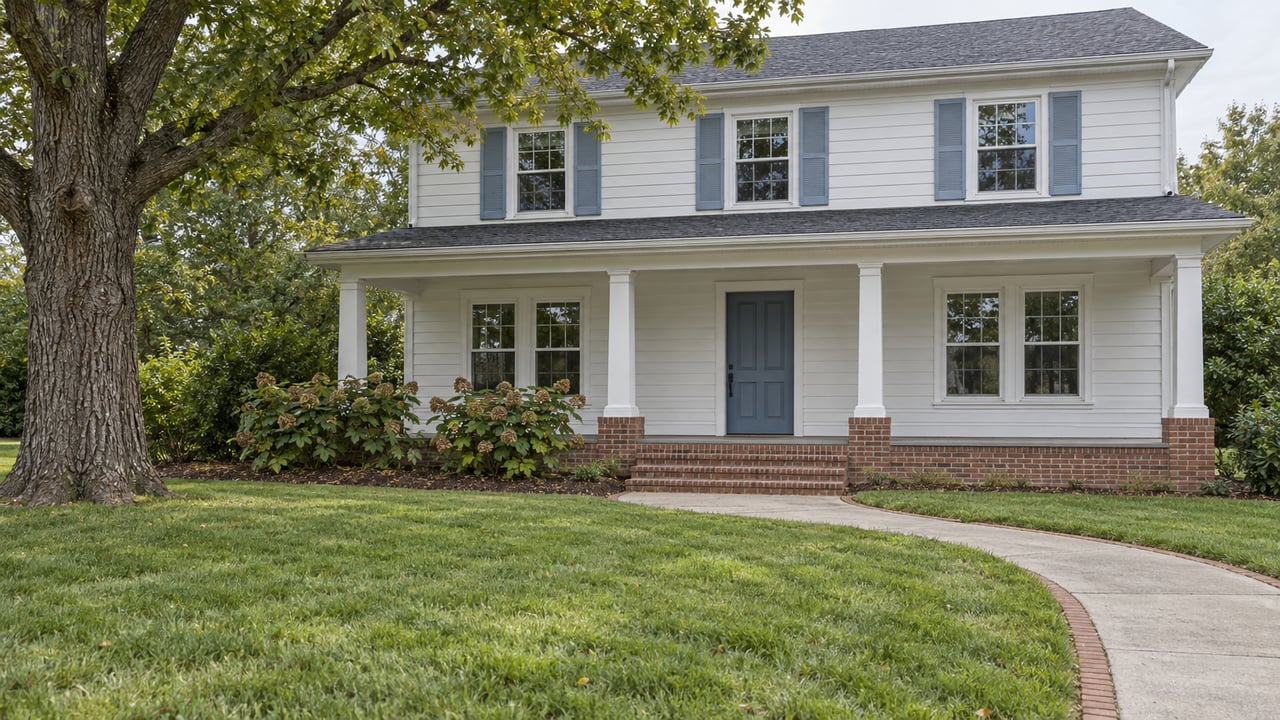
The Tax Bill on a Pebble Creek Listing Belongs to the Seller
October 15, 2026
October 15, 2026
The annual tax figure on a Pebble Creek listing tells you what the current owner pays. It reflects how long they've owned the home, whether they filed for South Carolina's owner-occupant rate, and which side of a fire district line their parcel sits on. A buyer doesn't inherit the first two. The third does carry over with the parcel, and it can be different for the house next door. In Greenville County your own number shows up in stages, and the bill that reflects your purchase usually arrives a year or more after you get the keys.
Calendar timing is what catches most people, so the walkthrough starts there.
Greenville County uses January 1 as the date of record for ownership. When a home changes hands after that date, both the previous owner's name and the new owner's name appear on that year's tax bills and assessment notices. The prior owner drops off the following tax year.
Real property is billed in arrears. Notices go out on or after October 1 and can be paid without penalty through January 15. The reset in value is on a separate timeline. Under state law, a sale counts as an assessable transfer of interest, and the property gets a market value dated December 31 of the year of the sale. That new value first becomes taxable the following year.
Here's how that plays out for a Pebble Creek closing during 2026:
At the closing table, a buyer will likely see a tax figure that is accurate and isn't theirs. Whatever gets prorated in 2026 is based on a value set before the sale. The bill that reflects your purchase price is still about a year away.
South Carolina assesses a qualifying owner-occupied legal residence at 4% of market value. Most other residential property is assessed at 6%. The 4% classification is tied to the owner, not the house. State law requires a new owner to apply after a change in ownership. Missing the deadline generally gives up the classification for that tax year, though local officials can extend it for reasonable cause.
Greenville County's Real Property FAQ says applications must be hand-delivered or postmarked by January 15. They can now be signed electronically, or downloaded, scanned and emailed. The county also says incomplete applications or ones missing documents won't be processed. An older, undated county PDF still says filings need an original paper signature. The live FAQ page is the more current guidance. State law also says that if you qualify for the 4% ratio during any part of a tax year, you get it for the whole year, as long as the application is filed.
The ratio itself isn't the biggest piece. The 4% classification comes with Act 388's exemption from school operating taxes on an owner-occupied residence. No separate application is needed once the 4% application is approved. School debt service millage still applies. In Greenville County's 2025 millage table, 141.2 of the 189.7 Greenville school mills are operating millage, and 48.5 are debt.
At a public breakfast on May 30, 2026, Greenville County Auditor Scott Case walked through a sample county tax notice. As reported by The Times Examiner, the sample showed $1,946.09 in taxes and fees before credits and $1,233.03 after the school tax credit.
Here's what that gap looks like on a hypothetical $400,000 home in tax district 260, one of the Taylors-area districts, using 2025 rates. This is an illustration only. It leaves out any other credits or fees that could appear on a real bill:
In this example, the 6% bill is about two and a half times the 4% bill, and the only difference between them is whether a legal residence application is on file. This can also work in reverse. A listing whose owner never filed for 4%, perhaps because it was a rental or a second home, can show a higher tax figure than a qualifying buyer would end up paying.
The ratio is one adjustment. The value underneath it is a second, and the sale changes that too.
South Carolina limits increases from countywide reassessment to 15% within a five-year period. That cap doesn't apply to the value set after an assessable transfer in the year it first becomes taxable. Greenville County's FAQ gives an example. A neighbor who bought in 2015 pays $600 and an owner who bought in 2021 pays $900, because state law removes the 15% cap when a transfer happens and requires a point-of-sale value dated December 31 of the year of the sale.
Timing matters in Pebble Creek right now. Greenville County's assessor says the 2025 countywide reassessment is complete. State law requires a reassessment every fifth year, so the next one would be implemented around 2030 unless the schedule moves. A seller who has owned for years has a 2025 value that may still be held below market by the cap. A buyer's value resets to market at the sale.
Case also explained that after a reassessment, taxing authorities generally roll back millage so a countywide rise in values doesn't automatically bring in more revenue. Rollback works across the whole tax base, though, so a property that gained more value than the district average can still see its bill go up. A point-of-sale reset works the same way. The millage rate applies to everyone in the district, and your bill depends on the value attached to your parcel.
Comparing tax figures between two Pebble Creek listings adds one more variable. Greenville County's list of fire and special purpose districts includes the Pebble Creek precinct, which votes at 1300 Reid School Road, under both the Piedmont Park Fire District and the Taylors Fire District. That list covers voting precincts, not individual parcels. Still, it shows that one neighborhood name can include more than one combination of millage.
Here's how much the totals vary across Taylors and Piedmont Park fire districts in the county's 2025 millage table:
| Tax district | Fire district | Other special districts | 2025 total mills |
|---|---|---|---|
| 260 | Taylors, 78.1 | Sanitation, 16.0 | 344.2 |
| 276 | Taylors, 78.1 | None listed | 328.2 |
| 277 | Piedmont Park, 62.1 | Sanitation, 16.0 | 328.2 |
| 279 | Piedmont Park, 62.1 | None listed | 312.2 |
The research for this post didn't confirm which of these districts any particular Pebble Creek address falls in. The county Auditor's millage rates page says rates vary among 136 tax districts in Greenville County. In the Times Examiner account of his presentation, Case pointed to the district number on the bill to explain why homes a short distance apart can pay different rates. The 32-mill spread between 312.2 and 344.2, applied to the $16,000 assessed value from the example above, works out to about $512 a year. That's enough to make two homes that look similar on paper carry different costs. The county's Real Property Tax Estimator takes a district number, and the parcel's current bill shows which number to use.
Greenville County Schools approved its FY27 budget on June 1, 2026 with no millage increase. As of mid-October 2026, this research didn't find a 2026 county millage table, so the 2025 rates above are the latest published figures.
The South Carolina Department of Revenue's tax legislation update dated October 1, 2026 lists no change to the 4% and 6% ratios. It does describe Act 140, which lets the 4% classification continue for a limited time after an owner's death. It also describes a temporary proviso that adds $25,000 to the $50,000 homestead exemption for eligible residents who are 65 or older, totally and permanently disabled, or legally blind. The proviso runs through June 30, 2027 unless lawmakers renew it. Several broader relief proposals were introduced on January 13, 2026, including H.4580, H.4595 and H.4599. The status snapshots reviewed show them referred to committee, not enacted.
State law allows a 25% exemption on the post-sale value for qualifying property assessed at 6%. It can't bring taxable value below current market value, and the assessor has to be notified. Greenville County's property tax savings handout lists January 30 as the application deadline.
State law allows a refund claim through the county assessor. It has time limits, generally two years from payment when no return was filed.
They can. Under state law, some trust transfers and changes in who owns an entity can count as assessable transfers, and the statute lists exceptions.
At Joanna K Realty, we look up a Pebble Creek parcel's tax district and the seller's assessment status before an offer goes in. That way your estimate is built on your own ratio and the post-sale value instead of the seller's bill. If you're comparing homes here, schedule a consultation and we'll go through the numbers with you. If you're selling, ask for a free home valuation.
This article is general information, not legal, tax or financial advice. Consult a qualified professional about your situation.

October 22, 2026
October 22, 2026
October 15, 2026
October 8, 2026
October 1, 2026

September 24, 2026
September 17, 2026
September 10, 2026
September 3, 2026
Joanna K Realty is committed to serving our clients with honesty, professionalism, and integrity at every step. Your goals come first let’s work together today.